The Electricity Supercycle: Efficiency is the new capacity
Nov 23, 2026
The new political regime, the Anthropic IPO, and the first cracks in the AI trade all point toward a turbine, gas-deliverability, and permission constrained world where the next megawatt comes from efficiency, not just more new build. This is the current state of the AI energy rush and where we see it going.
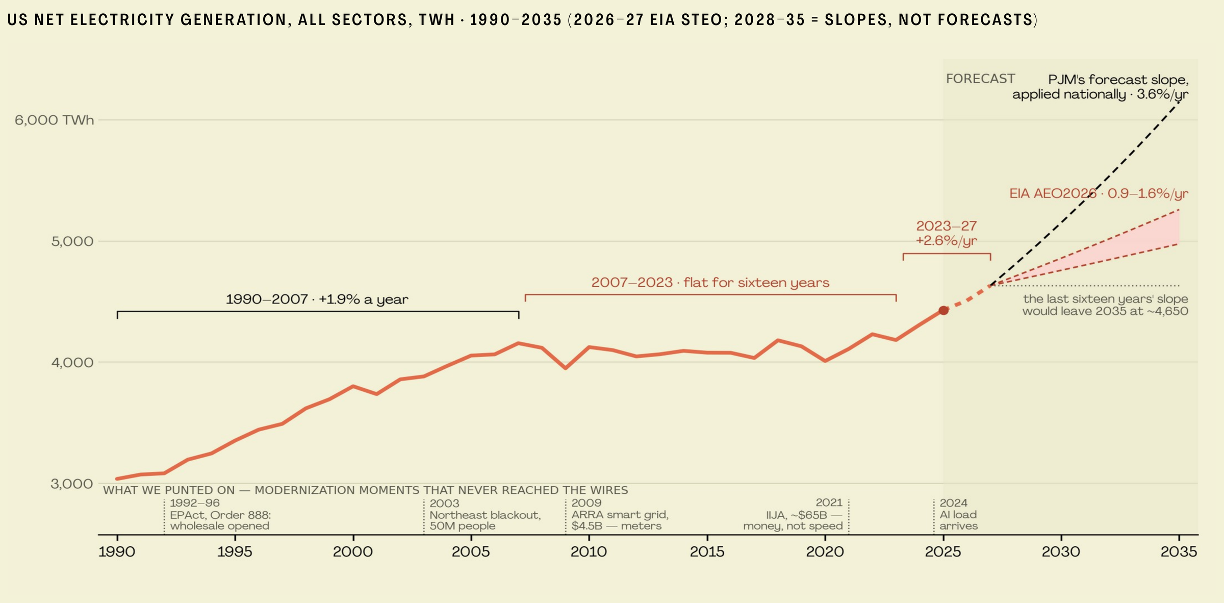
Electricity demand in the US was flat for almost 20 years, until 2023 kicked off the Electricity Supercycle: a multi-decade rebuild of how America makes, moves, and uses power.
From then on, the outlook in the power sector has been all up-and-to-the-right – more, more, more.
Phase One of that buildout had one rule: speed. Get megawatts ASAP, at any price and any cost to the environment or community.
Then came November 2026. Voters made their distaste for data centers clear as day at the ballot box, Texas elected a governor who campaigned on a moratorium, and we saw the first real cracks in the AI trade’s armor. In the midst of all this, Anthropic went public in the largest IPO ever, with signs of a bumpy ride through the rest of 2026.
The market broadly reads the turmoil as a demand shock. We think it marks the start of Phase Two: Demand is intact, but turbines, gas deliverability, and permission to build are now constrained all at once. In that world, efficiency becomes capacity, and it goes well beyond the grid.
Let’s look at how this electricity crunch came to be and where its currents point toward the next round of opportunities.
Phase One: speed at all costs (2023-2026)
Each constraint on AI gets priced only after it starts binding: chips in 2023, interconnection and speed-to-power in 2024, then turbines, transformers, and firm capacity in 2025–26.
At their 2026 peaks, energy stocks moved like meme stocks. Bloom up about 20x, GE Vernova up 6x, Vertiv and Talen up 5x in under two years.
In 2022, the entire US market for large power-generation gas turbines reportedly came to one unit, less than 100MW.
In 2025, US buyers ordered 51 GW, up 500x from 2022.
Today, GE Vernova has 122 GW of orders and slot reservations, booked into 2031.
Data centers have announced about 90 GW of on-site power, mostly gas, though only about 3 GW is running or under construction. Much of it is simple-cycle: the fastest to build and the least efficient to run (often ~40%).
Buyers have been paying whatever speed costs to stay ahead in the race for compute. New turbines run $2–2.5m per MW, used units about $1.5m per MW, and new units take six years to bring online, so developers are literally buying old jet engines. Given nuclear and other firm power won’t arrive at scale for a decade, any megawatts available today are at a significant premium.
New energy technologies get down the cost curve one of three ways: 1) government pays for the expensive early units (i.e. feed-in tariffs for solar and tax credits for wind), 2) regulators penalize the alternative (i.e. emissions limits on coal plants), or 3) buyers pay above-market prices because they need megawatts now. We’re seeing the third option at a scale not seen since the merchant gas boom of 1998–2002.
The last time buyers paid like this, the boom scaled a generation of gas turbines until it blew up. By January 2002, plant delays and cancellations totaled about 82 GW, more than a full year of today’s record orders. Calpine alone deferred 81 turbines and cancelled 35, Mirant and NRG went bankrupt, and Siemens expected US turbine orders to fall by roughly two-thirds. When the window closes, the companies that last are the ones whose product still wins once buyers stop paying premiums for speed.
The window is also selective. In September, Crusoe cancelled its Boom order, after agreeing to pay the high price of $1.25b for 1.21 GW – and kept its GE Vernova and ProEnergy turbines. Buyers pay for certainty of delivery, not novelty, and new entrants wait at the same foundries as GE for hot-section castings.
We think this window favors teams that can guarantee delivery, get more megawatts out of existing permits, and make the simple-cycle fleet more efficient – new considerations on top of the pure pay-for-speed electricity gold rush.
The turn: the election doesn’t stop the buildout
Data centers were on the ballot on November 3rd, and took a beating.
Voters backed limits on new facilities in 40 of 41 local measures, and 76% told NBC’s exit poll they didn’t want a data center in their community. In Texas, the state that courted the buildout hardest, Gina Hinojosa unseated Greg Abbott as Governor after promising to ban data center approvals until the Legislature passed protections.
We think this means three things are true at once:
First, scrutiny is real, and it will land hardest on gas. Behind-the-meter turbines sitting on the customer side of utility grids are the most visible part of the buildout and the most exposed. Two weeks after the election, Texas’s environmental regulator approved air permits for three data center gas plants totaling 3,500 MW, according to Public Citizen. By the group’s count, SpaceX’s 1,456 MW plant came in 1.14 tons of NOx a year under the threshold for full review. Permits engineered to sit just under the line will attract the next round of rules.
Second, we’ll keep building, and much of it will be gas. We expect demand for fast power to hold. The lame-duck permitting rush in Texas shows how much capital is waiting to move.
Third, governing isn’t campaigning. Within days of winning, Hinojosa said Texas remains pro-business: “It is not that I hate data centers.” Her agenda is transparency, lower costs for Texans, data centers paying their own way, and water and power for residents first. She still wants a moratorium until the Legislature acts, but the agenda behind it is cost allocation, not a permanent ban.
Still, GE Vernova has fallen about 17% and Vistra about 9% since the election as investors priced in a slower, costlier buildout. As of this writing, no cancellations trace to the election. The two most-cited pullbacks were both decided before the vote: SoftBank wrote off $3.7 billion after cancelling turbine reservations it had made in a rush to lock up supply, and Microsoft passed on an option at one Texas project.
Orders may slow, but demand remains massive: GE Vernova’s backlog hit $197 billion last quarter, with organic orders up 96%. Days after the vote, the Financial Times reported that Anthropic, which has since raised $81.3 billion in the largest IPO ever, had agreed in late September to pay about $3.4 billion for 1.7 GW of Caterpillar gas generators. The companies with the most capital are still buying every megawatt they can find.
So the question isn’t whether we keep building. It’s who pays, where, and how much it pollutes.
Siting above 100 MW was already a political and community decision; 2026 turned “can we get megawatts?” into “can we get megawatts the neighbors will accept?” That’s still the question – nothing is banned, speed to power is still the standard – but efficiency isn’t priced in yet.
Different futures, same shopping list
Demand doesn’t depend on who wins the AI race.
Pick your future: US labs keep their moats, open-weight models close the gap, Chinese labs catch up, a price war crushes margins…
In each one, the response is the same: more inference, more compute, more power. Infrastructure wins in more worlds than any lab or political party.
Now stack the other curves on top. Robots and autonomous vehicles run on batteries and motors. Reshored factories want electric process heat and automated fabrication. Tension with China turns someday-reindustrialization into purchase orders now. All of it pulls from the same transformers, switchgear, crews, and copper. An election can influence where those loads land and who pays, but it can’t shrink the demand.
Phase Two: efficiency becomes capacity (2027 - 2035)
Efficiency has carried the load before. It’s one reason demand stayed flat for sixteen years: between 2010 and 2018, the world’s data centers did about 550% more computing on about 6% more energy.
Phase One of the AI energy push set efficiency aside. Phase Two brings it back for different reasons.
There are three separate constraints that have a chokehold on electricity capacity:
Turbines. With order books stretching into the next decade and new entrants waiting at the same foundries as the incumbents, the machines already on order are the only ones anyone can count on.
Gas deliverability. The forward curve for NYMEX Henry Hub natural gas strip is flat into the 2030s. The 2028 physical market barely trades. Put simply: every model effectively assumes cheap gas forever.
But Chronometer’s Matthew Smith, who has modeled every US well and pipeline, estimates production can only add ~20 Bcf/d by 2030, about what approved LNG exports alone will need, with one new interstate pipeline built in a decade.
The buyers know it. Anthropic’s S-1 says so directly:
“As data center operators increasingly rely on natural gas-fired generation … we expect increased competition among users for the same natural gas supply and pipeline capacity in those areas. … We may be unable to secure firm gas supply and transportation during the development of a facility, causing a planned site to be delayed or abandoned.”
When tens of gigawatts of data center gas, the LNG trains, and the utility fleet all show up at once, every molecule becomes worth maximizing.
Permission. Siting above 100 MW is now a political allocation, and no new transmission is riding to the rescue for at least five years. Permits will be harder to get, meaning a minor air permit (the government authorization to build and run equipment that emits air pollution) will need to be maxed out.
Putting these three constraints together – when you can’t add turbines, can’t count on more gas, and can’t get bigger permits – the only megawatts left are the ones you stop wasting.
The new era of efficiency
Efficiency used to be sold on fuel savings. In Phase Two, we think it will be sold as capacity, at capacity prices.
The gas fleet is where this shows up first. The common claim is that on-site gas is a bridge: every campus plans to connect to the grid as soon as it can, because on-site power almost always costs more, and the turbines then drop to backup duty.
We think that’s directionally right about the destination but optimistic about the timeline. A full grid connection can take five to ten years, so for most plants ordered today, the bridge could last more than a decade. Call it “behind-the-meter” if you like, but five 10 MW turbines on one site is a power plant, and until the grid arrives it will run like one.
Efficiency decides what happens if and when the grid shows up. A simple-cycle plant at about 40% can’t compete with grid power and gets relegated to backup duties. One upgraded with waste-heat recovery or a bottoming cycle can keep running, and it has the best answer to the emissions scrutiny coming for these sites.
It’s already happening on the pipeline side: Tallgrass, the gas infrastructure company supplying power for Crusoe’s 1.8 GW campus, has ordered four waste-heat-to-power plants that turn compressor exhaust into about 46 MW with no new fuel and no water. At $2M per MW, a 50MW “combined-cycle” that gets 20% more electrons from the same fuel is worth roughly $20M of capacity on day one, before counting a dollar of fuel savings.
Efficiency needs to be a product that passes both tests: megawatts now and savings later, when the supply/demand gap normalizes.
The fair objection is that a conventional steam bottoming cycle needs water, capital, and steam equipment with a backlog of its own, and not every site is limited by its permit. That means real innovation is needed for efficiency to compete once the market calms down.
Where efficiency shows up next
Let’s consider the three zones efficiency gains can be made next and how they might happen.
Inside the fence: 800 volts. A 1 MW rack at 54 V draws 18,500 amps. Nvidia's Kyber racks move to 800 VDC in 2027, a 15x increase in 5 years. Power-hungry racks require that everything between the grid and the chip be replaced: transformers, switchgear, breakers, busbars. DC protection at 800 V is unsolved at scale (faults have to clear in microseconds, not milliseconds) and no incumbent dominates that gear yet.
Electricians cost 3x what they did a decade ago, 40% of the construction workforce retires by 2031, and an apprenticeship takes five years. Today, only a few percent of electricians are certified for high-voltage DC. A labor gap of this scale means whoever solves the installer shortage and DC protection is selling capacity, not just components.
New power efficiencies will continue to emerge. Already Nvidia says 800 VDC improves end-to-end power efficiency by up to 5%. And energy efficiencies will also become more valuable as chips and models improve, the marginal cost of a token converging with the marginal cost of electricity.
On the grid: smaller, more modular, and more flexible. If siting and interconnect above 100 MW is a political allocation, does the market start to scale mostly below 100 MW? And how do you future-proof a site deployed today? Flexibility designed in, zero-emission backup instead of diesel, grid-forming storage that steadies the grid rather than stressing it? The biggest efficiency resource is the grid itself, so we obviously need to get as much out of the wires we already built as possible.
In the market: the silicon spark spread. Token prices for comparable models are falling roughly 10x a year while power prices rise, and the margin between a GPU-hour and a megawatt-hour is unhedged. Gas plants have a spark spread. What's the silicon equivalent? Who makes that market? Will compute converge to the marginal cost of power?
Today, power is a small share of what a token costs; chips are most of it. But chips are a sunk cost once they’re installed, and tokens get cheaper every year while electrons don’t. Assuming token prices fall toward the marginal cost of producing one, that cost is increasingly the electricity, and the spread swings toward power.
The winners are whoever turns each permitted megawatt into the most tokens. Which makes efficiency, from the turbine to the chip, the margin.
What we’re looking for
Phase One rewarded whoever could deliver megawatts fastest. And that reward will continue. But Phase Two adds an underpriced (for now) race to get the most out of every turbine, every molecule of gas, every data center rack, and every permit.
The next efficiency opportunity may be something far more surprising than any of this. If you're building toward one, let me know about it; jrapperport@innovationendeavors.com.

Better databases, better models
Our investment in LanceDB

The New Implementation Economy
AI is upending the $550B enterprise software implementation industry.

AX is not the new DX, it’s the new UX
Over the past year, Agent Experience (AX) has become one of the most talked-abou...

Plugging in AI, Part 3: “The data center next door will lower your electric bill”
Two years ago, we wrote about the electricity gauntlet – the collision between A...

Our monthly dispatch for the technically curious