
The New Implementation Economy
Harpinder (Harpi) Singh, Josh Cohen
Nov 10, 2026
Today, the traditional systems integrator (SI) model is breaking.
For decades, software implementation has been one of the largest pools of spend in the enterprise. Businesses spend ~$550B/year on SIs like Accenture and Deloitte, and every IT professional knows the adage: “for every $1 spent on software, $6 is spent on services.”
In the last 12 months, coding agents have sharply reduced the cost of code generation. At the same time, enterprise CIOs face tremendous pressure to modernize with AI. These two shifts have opened the door for a swath of startups challenging incumbent SIs; many are among the fastest-growing companies of 2026.
It’s obvious that AI will reshape enterprise software delivery. What’s less obvious is: who will be the winners and losers in the transition?
The Traditional SI Delivery Model
At Innovation Endeavors, we’ve followed the SI ecosystem for years. After leading the Series A for Own – an enterprise data backup provider acquired by Salesforce for $2.1B in 2024 – we saw firsthand the central role SIs play in enterprise software delivery.
Broadly, SIs help enterprises build and manage custom software. Their projects run the gamut from SAP implementations to cloud migrations to greenfield app development, and they’re typically hired to help IT leaders achieve a business goal (“reduce time-to-quote for a key SKU”) or a modernization goal (“migrate from JD Edwards to SAP”).
Enterprises are idiosyncratic and often carry decades of IT debt, so SIs navigate this complexity across an implementation lifecycle:

Standard lifecycle for an SI project
The results aren’t always pretty. Despite heavy spend, IT leaders frequently bemoan missed timelines, budget overruns, and quality gaps.
We believe AI-native tools and teams will fundamentally reshape this delivery lifecycle. Across discovery, coding, testing, and incident response – agents are beginning to transform how enterprise software gets delivered.
The New Playing Field
Since the November ‘25 launch of Opus 4.5 – a breakthrough model for long-horizon autonomous agents – enterprise software delivery has changed dramatically.
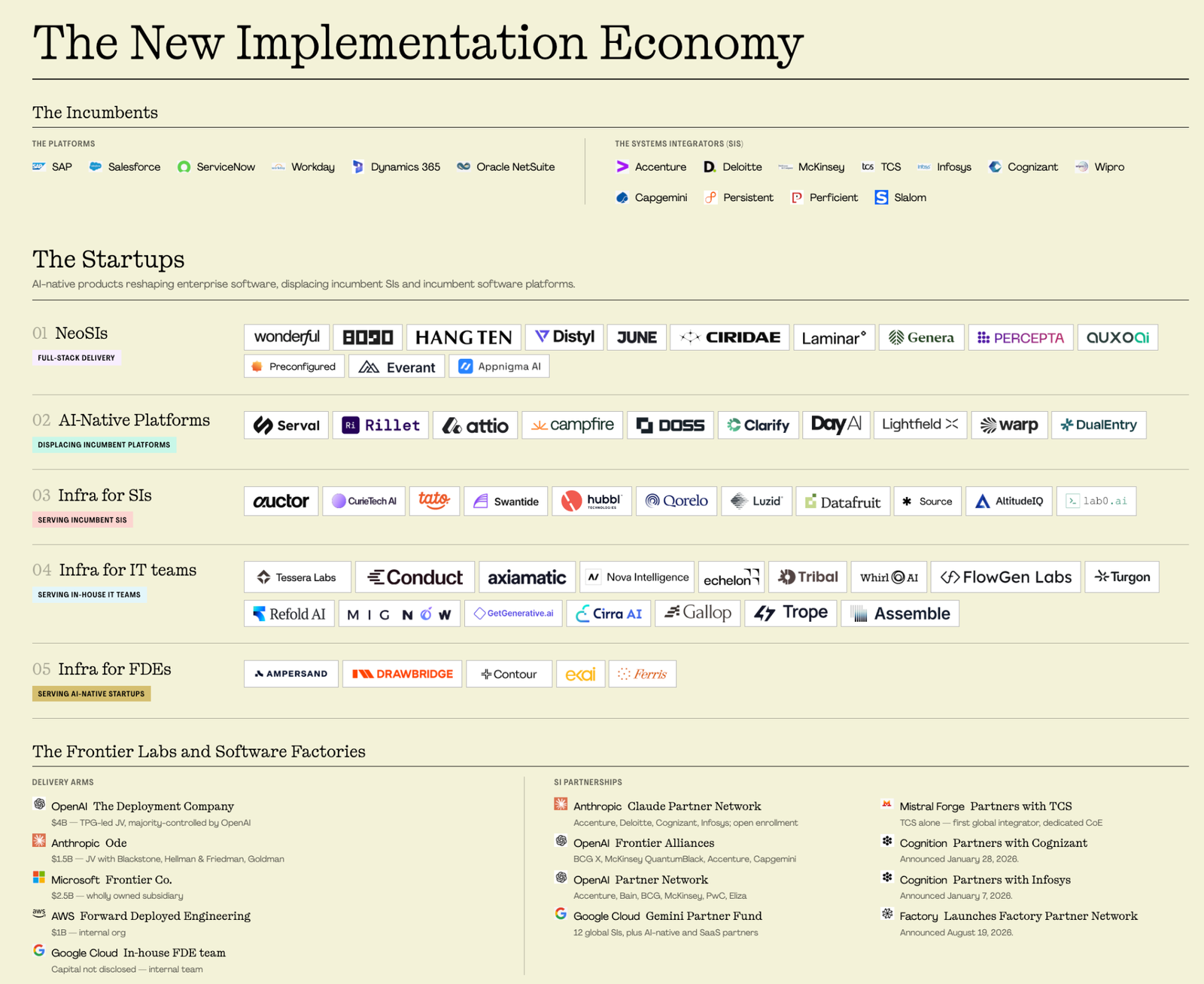
A new generation of startups is emerging across the implementation lifecycle. NeoSIs – like 8090.ai – are leveraging AI to deliver transformation projects more quickly than previously thought possible. Modernization-focused teams – like Tessera Labs – are completing years-long migrations in months. And AI-native competitors to the dominant platforms – like Serval for ITSM – are displacing SIs by bundling workflow automation and core software into one AI-first software package.
The underlying project work is also changing. Historically, SIs focused heavily on SAP, Salesforce, and ServiceNow implementations; today, demand is shifting towards AI transformation projects.
Frontier labs are playing an increasingly large role, developing SI partnerships while building their own services capacity. OpenAI launched the Frontier Alliances SI partnerships network in February and The Deployment Company in May; Anthropic launched its Claude Partner Network in March and Ode in July. For the big labs, implementation services are a critical channel for accelerating enterprise adoption.
We segment startup activity into five categories: (1) NeoSIs delivering full-stack delivery services, (2) AI-native platforms challenging incumbent software vendors, (3) SI infra providers selling tools to systems integrators, (4) IT infra providers serving in-house delivery teams, and (5) FDE infra providers serving forward-deployed engineering teams at AI-native startups.
Incumbent SIs
SI leaders increasingly see AI as an existential threat. Every major SI is pursuing top-down AI initiatives and heavily marketing AI capabilities when selling new projects.
Yet traditional SIs face an incentive problem. They bill hourly and operate large, labor-intensive organizations, so AI investments in efficiency may reduce billable hours and hurt the bottom line. These structural disincentives may slow AI adoption, leaving incumbent SIs vulnerable to faster-moving competitors.
NeoSIs
Newer, full-stack delivery firms like 8090.ai are directly challenging SIs by competing for MSAs on a range of projects, promising faster timelines and lower costs. Many teams are delivering 2x+ faster with 50% of the headcount.
We see immense opportunity here. By owning full-stack delivery, NeoSIs can continuously improve project speed and quality while capturing a meaningful share of the productivity gains.
The biggest challenges for NeoSIs? Meeting sky-high expectations on deeply complex projects, while maintaining strong margins. In a Fortune 10, one SAP implementation might touch 20+ departments and 100+ software systems. NeoSIs are making big promises and staffing up with FDEs. It remains to be seen whether NeoSIs can sustain attractive margins, delivery timelines, and FDE-to-project ratios at scale.
AI-Native Platforms
In each traditional enterprise software category – ERP, CRM, ITSM – AI-native companies are emerging as competitors to the incumbent platforms.

AI-native platforms build agents directly into product surface area, allowing users to offload manual work to LLMs. They also support configurable workflows, helping less technical users – who previously relied on implementation teams – to automate tasks independently. By reusing core software and automation capabilities across customers, AI-native platforms may achieve stronger margins than full-stack delivery firms building bespoke solutions.
That said, implementation risks loom as the AI-natives move from mid-market into complex enterprise environments. AI-natives market “out of the box” performance; in practice, FDE teams may be stretched thin while deploying across legacy systems.
Infra for SIs
Startups like Auctor are selling tools to incumbent SIs, helping them transition to AI-native project delivery.
This category faces a structural tension. SI executives increasingly see AI-adoption as an existential imperative, but their organizations remain optimized for labor-intensive delivery. Even when leadership embraces new tooling, widespread adoption may be slow.
Growth in this category will be capped by SI speed of tech adoption and willingness to pay for tools.
Infra for IT Teams
Startups like Conduct and Echelon sell directly to enterprise IT teams, helping internal engineers modernize traditional platforms like SAP. Most build agents for codegen and testing, using expert FDEs to bridge last-mile gaps. Ultimately, these infra providers displace SIs by empowering internal engineers to own more of an implementation.
As enterprises shift spend from headcount towards AI tooling, IT infra providers are well positioned to capture existing budgets. These companies may also develop durable technical advantages. Many pre-training datasets lack good enterprise system data (Dataweave integrations, anyone?), so IT infra companies which gain proprietary access can build competitive advantages by post-training models on enterprise codebases and employee traces.
Success here will depend on the ability to outcompete the frontier labs and software factory vendors. Anthropic and OpenAI are actively deploying Claude Code and Codex in the enterprise, and software factories like Cognition and Factory increasingly play in implementation services. This will be a hotly contested market.
Infra for FDEs
Newer startups like Ampersand and Contour are building tools for the modern FDE team. As AI-native products displace legacy business platforms, FDEs are emerging as a core function – FDE hiring is up 729% this year.
FDEs face enormous pressure today. AI-native vendors sell “out of the box” capability, customers expect AI to do everything, and FDEs are left bridging the gap. Because implementation is often a revenue blocker, FDE productivity will become increasingly critical in ‘27.
We expect FDE teams to invest in tooling for project management, process capture, implementation, and integration management. Given how nascent this category is, we expect significant evolution over the next 12 months.
What defines product excellence in this category?
Across categories, the strongest teams are building AI platforms for the implementation lifecycle, then either selling these tools to customers or using them internally to power services delivery.
We've seen teams build agents to automate some mix of customer discovery, project planning, implementation, test, delivery, documentation, and maintenance. Data migration, historically one of the most challenging areas of implementation, is an emerging area of focus. Most teams are building technical advantages at the model layer and harness layer to support end to end completion of implementation tasks.
At the model layer, we mostly see teams post-training foundation models with proprietary datasets, which might include:
- Enterprise backlog data
- Captured employee implementation traces
- Synthetically generated implementation traces
- Labeled trace data from employee review of work
At the harness layer, we see techniques such as:
- Instance mapping to generate structured representation of an enterprise environment
- Process mining and recording tools for capturing operations workflow
- Context engineering to deliver relevant platform context and instance context for a specific task
- Skills for browser navigation of platform GUIs
- Adapters to translate internal system concepts across platforms
Ultimately, the strongest products will be agent systems that reliably complete complex implementation tasks with minimal human intervention.
Predictions for 2027
Software implementation has been one of the biggest pools of spend in the enterprise for decades, and for good reason. Large companies are extremely complex. Custom workflows like “source-to-pay” and “hire-to-retire” – often cross multiple departments, touch 100+ software systems, affect hundreds of stakeholders, and directly impact the bottom line.
Because of this complexity, custom software implementation isn’t going anywhere. In 2027, we predict that:
As delivery gets faster and cheaper, project volume will increase
Enterprises will continue to prioritize cost, speed, and quality, and custom software will keep getting cheaper. We expect that, thanks to the Jevons Paradox, this will dramatically increase the number of software and AI projects being delivered in the enterprise.
Traditional platforms will have staying power
If you have a lot to build, and modifying existing systems is risky — you’ll opt to keep traditional systems where possible. For most enterprises, the ROI of rebuilding a CRM from scratch won’t justify the risk and opportunity cost.
We predict that SAP, Salesforce, and ServiceNow will remain a core part of the enterprise software ecosystem for the next few years.
“AI Transformation” will still involve plenty of good-old deterministic code
While most startups are selling “long-horizon agents for X”, most business process is — by design — repetitive. Businesses will prefer deterministic workflow to reduce risk and cost, and as a result, will be selective about where intelligence is needed within a loop.
Much of the long-horizon workflow that agents complete will get “cached”, “validated”, then “replayed” — in other words, it will turn into boring old custom software.
Areas of Opportunity
As AI reshapes implementation, we see immense opportunity for teams building across the implementation lifecycle. We are particularly excited about teams who are:
-
Building AI-native products that displace the platform+SI model. As the cost of custom code falls, businesses will prefer bespoke workflow automations that match their process over generic primitives they have to work around. This opens the door for product-first companies to ship easy-to-build automations for the last mile, displacing old platform+SI business models. We see opportunity in a long list of cross-functional processes where the incumbent platform is decades old and the work is high volume, mostly deterministic, and easy to verify, often in areas such as IT, ERP, HR, quote-to-cash, billing, and field service.
-
Going deep on process discovery. In 2027, we believe process discovery will be the single biggest bottleneck in implementation. As the cost to produce software falls, what will matter most is a delivery team’s ability to efficiently capture an enterprise’s workflows and idiosyncrasies. There is a large design space here across a number of areas, including active / passive session recording and agents for proactive interview loops.
-
Innovating in enterprise verification. For many enterprise systems, no one individual understands the complete picture of upstream and downstream dependencies. This is what makes enterprise change so challenging and risky. Today, we’re seeing strong implementation performance in highly verifiable tasks, such as code modernization tasks in codebases with high test coverage. But we predict that for many business systems, validation/verification will be hard — either because system dependencies are complicated, or because certain processes are highly subjective. We see opportunity for teams to explore innovative verification techniques – such as formal methods for systems analysis, new approaches to instrumentation and release management, or higher quality verifiers for domain-specific model post-training – to ultimately deliver higher quality implementation projects.
The enterprise implementation market is large enough to support multiple winning approaches. AI-native product builders like Rillet, delivery firms like Distyl, and infrastructure providers like Ampersand all have a role to play as the volume of enterprise implementation projects grows.
Through 2027, we expect a massive amount of change in enterprise implementation. If you are building in this space, we’d love to meet. Email us at harpi@inn.vc / jcohen@inn.vc.

AX is not the new DX, it’s the new UX
Over the past year, Agent Experience (AX) has become one of the most talked-abou...

Plugging in AI, Part 3: “The data center next door will lower your electric bill”
Two years ago, we wrote about the electricity gauntlet – the collision between A...
Meet Soffi: the first truly collaborative workplace for product development
Over the last few years, AI has undeniably transformed the pace of software engi...

How Agents Use Systems Differently
Increasingly, coding agents are the ones provisioning and interacting with syste...

Our monthly dispatch for the technically curious