When Machines Build for Machines
Mar 18, 2026
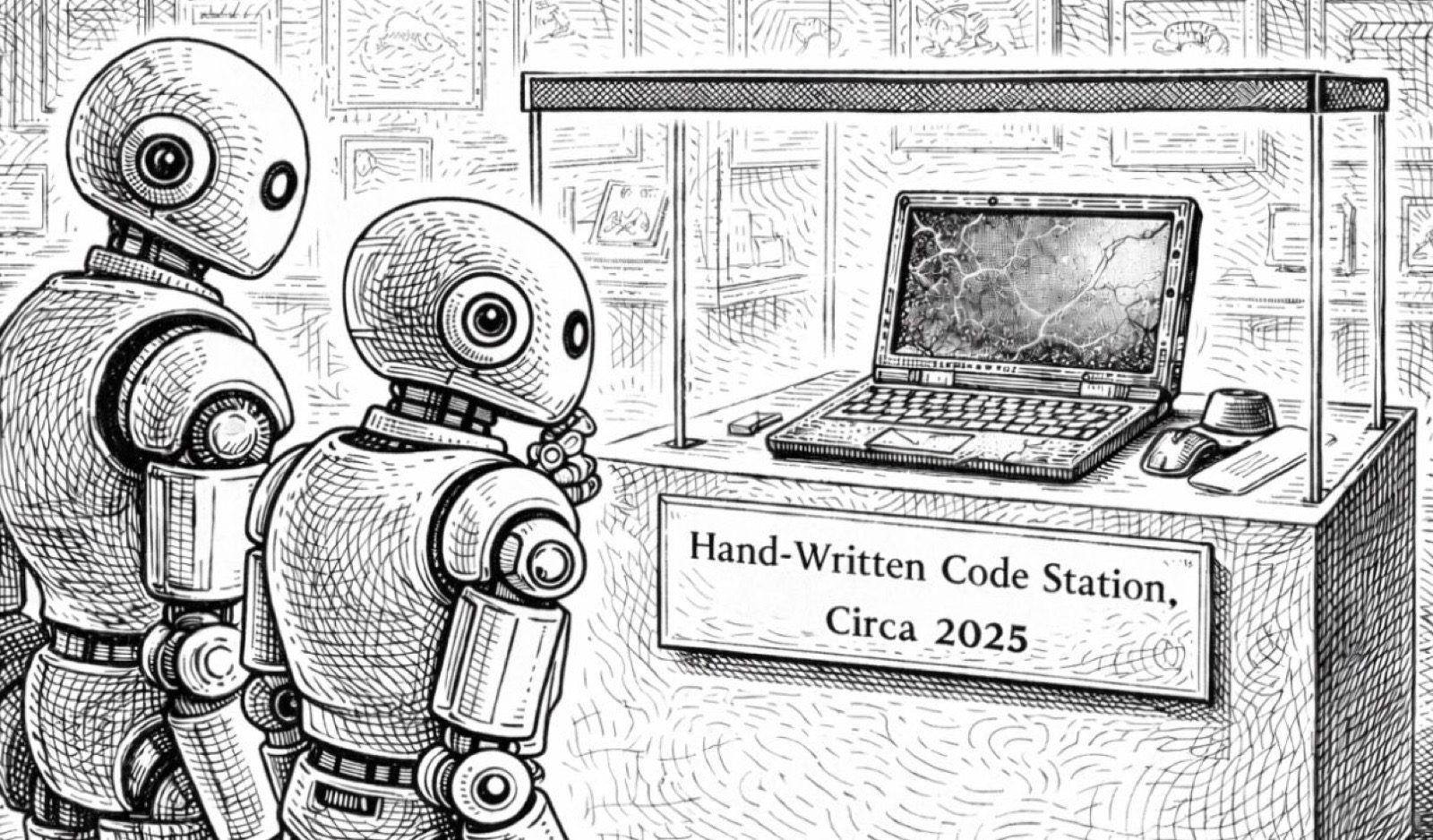
For as long as technology has existed, it has been built by humans, for humans.
This seems obvious, but it is the deepest constraint on everything we have ever built. Consider an optical sensor. Billions of light wavefronts reach our sensors every moment, carrying information in immense resolution and dimensionality. But we designed sensors to flatten, integrate, and discard most of that information, reducing it to what a human eye can interpret. We still design sensors as if there is a person behind the camera. As a result, most of the richness of the physical world has been left outside the reach of our technology.
The same is true of software. Every application, every interface, every system we have built has been shaped by what humans could imagine, what we had the expertise and capital to produce, what we had the time to build, and what the human consumer on the other end could comprehend. We were constrained on all sides.
That is all changing. We are entering the agent economy, and it represents two shifts happening simultaneously, each releasing a different set of constraints that have shaped technology for its entire history.
Built by Agents
The first shift is on the production side. AI agents are removing the constraints that have always governed what could be built: the need for large teams, significant capital, and years of development time.
Companies that would have needed hundreds of engineers a year ago are shipping products with a handful of people and AI agents. Entire categories of companies are being created that simply could not have existed before, not because the ideas are novel, but because the cost and speed of building have changed by orders of magnitude.
There is a subtler shift here too. Almost everything we have produced historically has been static, or relatively static. Software shipped in periodic releases because the cost of humans coordinating, gathering feedback, iterating, and shipping was high. Hardware systems like optical sensors were designed years in advance and frozen at the point of manufacture. The rhythm of production was dictated by the rhythm of human coordination. When agents build, that constraint disappears. Software can be generated on the fly, adapted per user, per context, in real time. Sensing systems can reconfigure themselves continuously rather than operating through fixed optics designed years before the product ships. The product is no longer a snapshot of what someone decided to build at a point in time. It is a living system that evolves continuously.
Push this further and the concept of a "product" itself starts to dissolve. The entire infrastructure of software, how we sell it, distribute it, license it, update it, assumes a thing that persists. An app. A platform. A version number. But if software can be generated on the fly for a specific user at a specific moment, there may be no product at all in the traditional sense, just a continuous act of creation that materializes when needed and reshapes itself each time.
The volume of code being written in the world is about to increase by many orders of magnitude. A growing share of it will never be seen or reviewed by a human. Every layer of the stack, from version control to cloud infrastructure to databases to programming languages, was designed assuming a human author. Those assumptions are breaking down.
When execution becomes this abundant, the scarce resource changes. This is the pattern of every major technology transition: when one constraint falls away, value shifts to whatever is scarce next. Compute became cheap; value moved to software. Mobile became free; value moved to the services that ran on it. I spent decades building companies where the constraint was always hiring enough engineers fast enough. That constraint is gone. Execution itself is becoming abundant, and the scarce resource is shifting to the human who knows what to build, which problems matter, and what good looks like. The founders and teams that win will be the ones who see most clearly.
Built for Agents
The second shift is on the consumption side, and it may be the more profound one. When the end consumer of technology is no longer a human, the output no longer needs to be constrained by what a person can sense, comprehend, or attend to.
A sensor designed for AI does not need to produce an image. It can capture, reason about, and act on the full complexity of light, revealing biological signals at the cellular level that are invisible to standard microscopy, detecting structural defects buried deep inside semiconductor wafers, sensing the physical world at a resolution and dimensionality that human perception could never reach. Today, most of the richness of reality is left outside the reach of AI because we still design the instruments that feed it as if a person needs to understand the output. Remove that constraint, and entirely new fields open up.
Consider what this means for something as critical as medicine. A CT scan is a rich three-dimensional reconstruction of human anatomy. But since 1981, we have measured whether a cancer drug is working by having a radiologist measure tumor diameter, a single number extracted from an immensely complex image, because that is what humans can consistently interpret and communicate. An AI reading that scan does not need the tumor reduced to a diameter. It can work with the full dimensionality of the image, detecting patterns that predict whether a patient will respond to treatment far earlier and more accurately than the simplified measurement ever could. The diameter was never the point. It was a compression artifact, a way to fit the complexity of a human body into the limits of a human mind. When the consumer is an agent, that compression is no longer necessary, and everything it discarded becomes available again.
Or consider software itself. For decades, source code has been written for two audiences: the machine that executes it and the human who needs to understand it next. That second audience has shaped everything, from programming languages to naming conventions to architectural patterns designed for "maintainability." It is also why codebases only grow. Understanding what was already written is so difficult, and becomes more so with every team change and language migration, that it is often easier to write new code than to comprehend the old. An agent consuming code does not need it to be readable. It can work with whatever representation is most efficient for the machine, refactoring or regenerating entire systems as needed, without the accumulated weight of code written to be understood by a person who may never arrive. What we call technical debt is really human-comprehension debt. Remove the human reader, and that debt disappears.
This is a fundamental shift in what technology can do. We are moving from systems limited by human bandwidth to systems that operate across far more dimensions than humans could ever access on their own.
Beyond What We Can Comprehend
The hardest part of the agent economy will be reckoning with what it makes possible.
Push the logic of this essay forward and you arrive somewhere genuinely disorienting. Every technology transition in living memory has been underestimated at the start. This one is too, but for a different reason: not because people doubt it will work, but because what it makes possible is, in a real sense, beyond what we can fully picture. We are building systems whose outputs may exceed not just our ability to produce them, but our ability to evaluate them. A medical AI may reach conclusions no doctor can verify through traditional means. An agent may produce a codebase that works flawlessly but that no engineer fully understands. We are entering a world where the things we build may be, in a meaningful sense, beyond us.
The implications stretch well beyond products and technology. If what we build is no longer constrained by human coordination, what happens to the company as an organizational unit? If expertise can be acquired on demand by an agent, what does a career built on knowledge accumulation actually mean? If an increasing share of valuable work is done by machines, what happens to economic systems built on pricing human time? These are not questions for a future decade. They are questions this generation of founders, policymakers, and citizens will have to answer.
But the starting point is here, in the design space that has just opened up. The constraint is no longer what we can build. It is what we can imagine, and whether we are willing to follow that imagination into territory we cannot fully map in advance.
One of us has built technology at the largest scale in history. The other invests in the founders building what comes next. We wrote this together because neither vantage point is sufficient on its own, and because the answer will not come from any single perspective. It will come from the collision of many: founders, scientists, policymakers, and yes, the agents themselves.
That is a challenge worth rising to.
The floor is open.
Eric Schmidt and Dror Berman
Special thanks toJonathan Rosenberg,Tomer Cohen,Effi Fuks Leichtag,Nadav Grossinger,Eran Shir,Janine Brady,Alexa Dennett,Nick Olsen,Harpinder Singh,Davis Treybig, and Scott Brady for their feedback on earlier drafts of this piece.

Plugging in AI, Part 3: “The data center next door will lower your electric bill”
Two years ago, we wrote about the electricity gauntlet – the collision between A...
Meet Soffi: the first truly collaborative workplace for product development
Over the last few years, AI has undeniably transformed the pace of software engi...
How Agents Use Systems Differently
Increasingly, coding agents are the ones provisioning and interacting with syste...
A decade of software infrastructure
Today, we are excited to announce Kenneth Auchenberg is joining the team at Inno...

Our monthly dispatch for the technically curious